QCN9024 vs. QCN9224: Wi-Fi 6 and Wi-Fi 7 Chipset Showdown — Performance, Configuration, and Applications Compared
With the rapid evolution of wireless networking, understanding the differences between the latest Wi-Fi chipsets is crucial for both enthusiasts and professionals. This article provides an in-depth comparison between the **QCN9024** (a popular Wi-Fi 6 (802.11ax) chipset) and the **QCN9224** (a cutting-edge Wi-Fi 7 (802.11be) chipset). We will cover aspects like performance, configuration, key features, and ideal applications for each chipset.
please contact: sales@wallystech.com
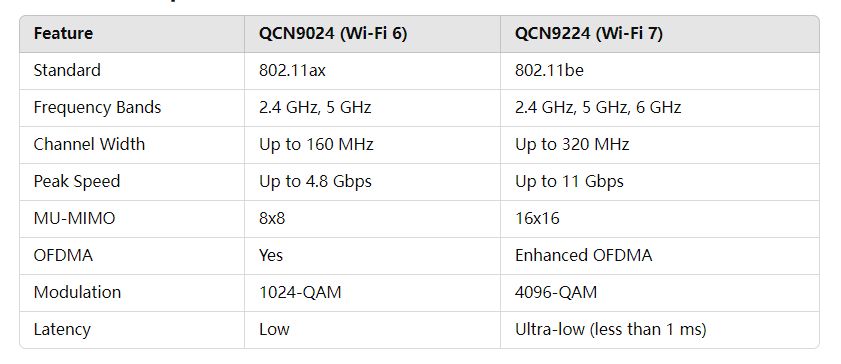
### 1. **Technical Specifications**
### 2. **Performance Comparison**
- **Speed & Throughput**: The QCN9224 offers nearly **double the peak speed** of the QCN9024, thanks to its ability to use wider channel bandwidth (up to 320 MHz) and improved modulation (4096-QAM). This makes it ideal for high-demand environments requiring ultra-fast connectivity.
- **Latency**: With a latency that’s **significantly reduced**, the QCN9224 excels in real-time applications such as online gaming, video conferencing, and VR/AR streaming.
- **Efficiency**: Both chipsets support OFDMA, but the QCN9224 features **Enhanced OFDMA**, allowing more efficient data transmission to multiple devices simultaneously, reducing congestion in busy networks.
### 3. **Configuration and Compatibility**
- **Backward Compatibility**: Both chipsets maintain compatibility with previous Wi-Fi standards (802.11a/b/g/n/ac/ax), but QCN9224 expands support to the newer **6 GHz band**, enabling more channels and less interference.
- **Channel Management**: QCN9224’s support for **320 MHz channels** gives it a significant advantage in maximizing throughput, especially in environments where there are fewer legacy devices occupying the spectrum.
### 4. **Key Features**
#### QCN9024 (Wi-Fi 6):
- **8x8 MU-MIMO**: Supports multiple devices with better load management.
- **Target Wake Time (TWT)**: Enhances battery life for IoT and mobile devices by scheduling communication times.
- **Beamforming**: Optimized signal strength and coverage.
#### QCN9224 (Wi-Fi 7):
- **16x16 MU-MIMO**: Improved support for dense networks, handling more simultaneous connections.
- **Multi-Link Operation (MLO)**: Connects to multiple bands simultaneously, ensuring **seamless switching and redundancy**.
- **Extreme High Throughput (EHT)**: Designed for applications that require **ultra-fast data** such as 8K video streaming or cloud gaming.
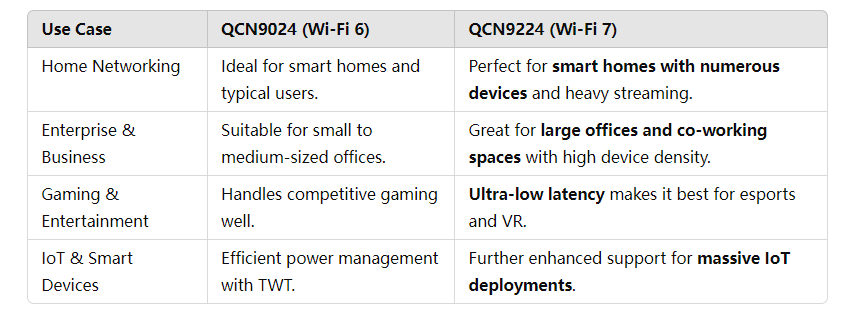
### 5. **Application Scenarios**
### 6. **Conclusion**
Both QCN9024 and QCN9224 are powerful chipsets, but they cater to different requirements. The QCN9024 excels in environments where robust, reliable connectivity is needed without overwhelming device congestion. Meanwhile, the QCN9224 is designed to handle next-generation demands with **higher throughput, more efficient multi-device support**, and **ultra-low latency**, making it the go-to solution for future-proofing networks.
### **Key Takeaways:**
- Choose **QCN9024** for solid Wi-Fi 6 performance in homes, small businesses, or regular use.
- Opt for **QCN9224** if you need cutting-edge Wi-Fi 7 technology with higher speed, wider channels, and enhanced device support, especially in high-traffic environments.
By understanding the strengths and applications of each, you can make an informed decision for your networking needs.


Comments
Post a Comment