With the gradual commercialization of Wi-Fi 7 (IEEE 802.11be), wireless devices are facing increasing demands for higher throughput, lower latency, and multi-band collaboration. The Qualcomm QCN9224 is a high-performance Wi-Fi 7 wireless chipset designed to meet these requirements, targeting high-end CPEs, enterprise equipment, industrial devices, and advanced embedded platforms.
1. Product Positioning---sales@wallystech.com
QCN9224 is positioned as a Wi-Fi 7 wireless client / radio chipset, suitable for:
- High-performance routers and gateways
- Enterprise and industrial wireless devices
- Embedded systems (ARM / x86 platforms)
- Custom wireless solutions requiring future-proof connectivity
It delivers significant improvements in speed, reliability, and spectral efficiency, making it ideal for next-generation wireless applications.
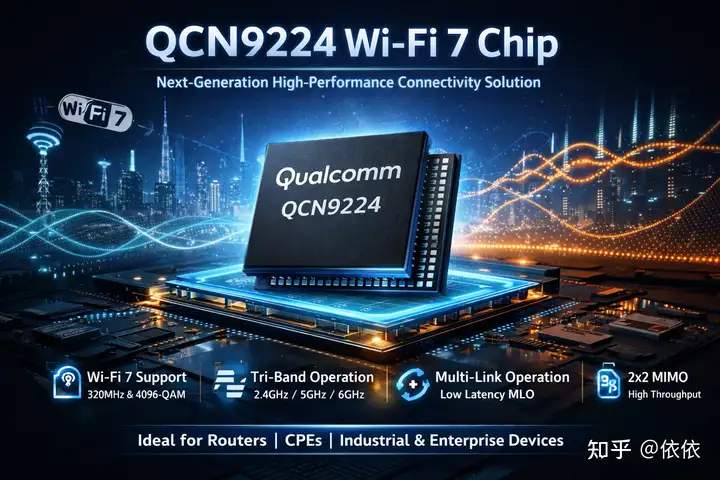
2. Key Technology Features
2.1 Wi-Fi 7 (IEEE 802.11be) Support
QCN9224 fully supports the core features of Wi-Fi 7, including:
- Ultra-wide bandwidth (up to 320 MHz)
- 4096-QAM modulation for higher data rates
- Lower air-interface latency
- Improved spectral efficiency
Compared to Wi-Fi 6 / 6E, Wi-Fi 7 provides a substantial leap in peak throughput and overall performance.
2.2 Tri-Band Operation: 2.4 GHz / 5 GHz / 6 GHz
QCN9224 supports the latest 6 GHz band, while maintaining backward compatibility with:
- 2.4 GHz
- 5 GHz
- 6 GHz
The newly available 6 GHz spectrum offers cleaner channels with minimal interference, enabling more stable and predictable wireless performance—especially in dense deployments.
2.3 Multi-Link Operation (MLO)
As a flagship Wi-Fi 7 capability, Multi-Link Operation (MLO) allows QCN9224 to:
- Transmit and receive data simultaneously across multiple bands
- Aggregate bandwidth or dynamically switch links
- Achieve lower latency, higher reliability, and better load balancing
This feature is particularly beneficial for real-time applications, industrial control, cloud gaming, AR/VR, and ultra-low-latency networking.
2.4 Optimized MIMO Architecture
QCN9224 typically adopts a 2×2 MIMO architecture, offering an excellent balance between performance, power consumption, and system cost:
- High throughput in compact designs
- Suitable for power-sensitive or space-constrained devices
- Flexible antenna and RF design options
2.5 Standard Interfaces and System Compatibility
The chipset connects to host platforms via PCIe, enabling:
- Seamless integration with ARM and x86 systems
- Compatibility with Linux-based operating systems
- Faster development cycles and easier system validation
3. Typical Application Scenarios
QCN9224 is well suited for a wide range of applications, including:
- Wi-Fi 7 routers and CPEs
- Enterprise access points
- Industrial wireless terminals
- Edge computing and AI devices
- High-performance embedded systems
- 6 GHz–enabled wireless solutions
It is especially attractive for applications requiring low latency, high reliability, and long-term scalability.
4. Key Advantages Summary
| Category | Advantage |
|---|---|
| Future-ready | Native Wi-Fi 7 support |
| Multi-band | 2.4 GHz / 5 GHz / 6 GHz |
| Low latency | MLO technology |
| High performance | Wider bandwidth & higher modulation |
| Easy integration | PCIe interface, Linux ecosystem |
5. Conclusion
The Qualcomm QCN9224 represents the next step in Wi-Fi connectivity evolution. By combining Wi-Fi 7 performance, multi-band flexibility, and mature system compatibility, it provides a powerful and scalable wireless foundation for next-generation networking products.
For manufacturers and solution providers looking to deploy Wi-Fi 7 ahead of the market curve, QCN9224 is a highly competitive and future-proof choice.
Comments
Post a Comment