The Qualcomm IPQ9574 is the flagship mainstream chip for current high-end Wi-Fi 7 routers, serving as the core solution for home and commercial high-performance mesh networking from 2025 to 2026. With the upcoming launch of Wi-Fi 8 (IEEE 802.11bn), most users wonder: Does Wi-Fi 8 deliver double faster speed? Is it worth upgrading? This article cuts out complicated technical parameters, and makes a straightforward comparison of design concepts, practical experience gaps and purchase suggestions between the mature IPQ9574 Wi-Fi 7 solution and the next-generation Wi-Fi 8 standard.
1. Core Positioning: Completely Different Design Philosophies
Qualcomm IPQ9574 Wi-Fi 7: Focus on Extreme Single-Device Speed
Wi-Fi 7 powered by IPQ9574 prioritizes peak wireless speed. Adopting 320MHz ultra-wide channel, MLO multi-link aggregation and 4096-QAM modulation technology, it maximizes the instantaneous transmission speed of single terminals such as smartphones and PCs.
However, it has obvious inherent drawbacks. During multi-node mesh roaming, multi-device concurrent connection and mobile gaming scenarios, users will face noticeable ping spikes, temporary network disconnection and network congestion. All routers work independently without coordinated network optimization.
Wi-Fi 8: No Faster Peak Speed, Focus on Full-Network Stable Connection
Wi-Fi 8 abandons the blind pursuit of higher single-device peak speed, retaining the same physical layer rate as Wi-Fi 7. Its core upgrade targets pain points of Wi-Fi 7, including full-network coordination, ultra-low latency, seamless roaming and stable connection for massive IoT devices, bringing overall stability improvement rather than speed improvement.
2. Key Practical Performance Differences
2.1 Network Speed: Identical Peak Rate, Big Gap in Real-World Stability
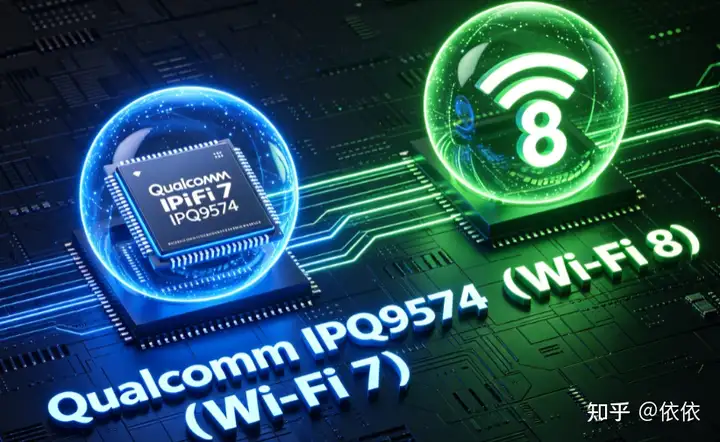
- IPQ9574 Wi-Fi 7: Excellent close-range peak speed; sharp speed drop and severe fluctuation when passing through walls or connecting dozens of devices simultaneously
- Wi-Fi 8: Same theoretical peak speed as Wi-Fi 7; greatly enhanced anti-interference capability, stable wall-penetrating speed and better average performance in complex home environments
2.2 Mesh Roaming: The Most Intuitive Experience Gap for Home Users
- IPQ9574 Wi-Fi 7: 20-50ms temporary disconnection during cross-room roaming, causing sudden ping surges in mobile games and short live stream freezes
- Wi-Fi 8: Cross-AP cooperative roaming with sub-millisecond seamless handover; zero perceived network interruption, supporting smooth gaming and live streaming while moving around the house
2.3 Multi-Device Concurrency and Anti-Interference Performance
- IPQ9574 Wi-Fi 7: Network congestion occurs when more than 30 devices connect simultaneously; overall network performance declines sharply in crowded scenarios like offices and shopping malls
- Wi-Fi 8: Automatic interference avoidance among multiple access points; supports stable online access for over 1,000 terminals, perfectly fitting dense commercial scenarios and smart home systems with massive IoT devices
2.4 Chip Hardware Process and Power Consumption
- Qualcomm IPQ9574: 14nm manufacturing process without dedicated AI acceleration unit; high CPU occupancy and severe heat generation under high network load
- Next-Gen Wi-Fi 8 Chips: Advanced 6nm process with built-in dedicated AI network accelerator; intelligent interference prediction and channel optimization, lower heat generation and power consumption. It also doubles the battery life of smart IoT devices.
2.5 Network Latency Performance
- Wi-Fi 7: Basic low latency for daily gaming, but obvious latency jitter in complex network environments
- Wi-Fi 8: Deterministic ultra-low latency with nearly eliminated jitter, meeting strict requirements for professional esports, wireless VR and industrial wireless control equipment
- sales@wallystech.com


3. Quick Comparison Table
| Comparison Item | Qualcomm IPQ9574 (Wi-Fi 7) | Wi-Fi 8 |
|---|---|---|
| Theoretical Peak Speed | Over 10Gbps, top-tier single-device speed | Consistent with Wi-Fi 7, no speed upgrade |
| Mesh Roaming Experience | Temporary disconnection, obvious ping spikes | Zero-sensing seamless roaming, stable connection all the time |
| Multi-Device Anti-Interference | Network congestion with dozens of connected devices | Multi-node collaborative anti-interference, supporting massive concurrent terminals |
| Chip Manufacturing Process | 14nm, no built-in AI accelerator | 6nm, built-in dedicated AI network acceleration |
| Product Availability | Massive stock, continuously dropping price | Mass production in 2027 with high initial cost |
4. Purchase Advice for End Users
Choose IPQ9574 Wi-Fi 7 Router (Best Choice for 90% of Users)
For small and medium-sized houses with a single router, daily streaming, online gaming and local NAS file transmission, IPQ9574 Wi-Fi 7 routers are fully competent. With falling market prices, this mature solution remains cost-effective and future-proof for the next 3 to 5 years.
Wait for Wi-Fi 8 Devices If You Meet the Following Needs
Wi-Fi 8 is worthy of waiting for users with large villa full-house mesh networking, dense network scenarios in studios and stores, professional esports, wireless VR devices, and smart homes with hundreds of IoT sensors. Official mass-market Wi-Fi 8 products will be available in 2027 with mature performance.
Conclusion
Qualcomm IPQ9574 Wi-Fi 7: Focus on faster single-device speed, ideal for users pursuing extreme wired-equivalent wireless speed.
Wi-Fi 8: Focus on more stable whole-home network, ideal for users pursuing zero-lag seamless roaming and reliable dense network connection.
Wi-Fi 8 is not an iteration of network speed, but a comprehensive upgrade of overall network stability. There is no need for ordinary users to blindly pursue the latest standard. The mature Qualcomm IPQ9574 Wi-Fi 7 solution is still the most cost-effective option currently.
Comments
Post a Comment