As wireless connectivity becomes essential across hotels, offices, schools, factories, warehouses, hospitals, shopping malls, and industrial sites, businesses are no longer satisfied with simply having WiFi coverage. They need networks that provide reliable connectivity, seamless mobility, and easy scalability.
Traditional wireless networks built around a single router or standalone access points often struggle to deliver consistent coverage in large environments. As a result, Mesh WiFi has become one of the fastest-growing wireless networking technologies for enterprise and industrial applications.
What Is Mesh WiFi?
Mesh WiFi is a wireless networking architecture where multiple access points (Mesh nodes) work together as a single, unified network. Instead of relying on one central router, each node communicates with the others to provide continuous wireless coverage across the entire site.
Unlike traditional wireless deployments, Mesh networks can automatically discover new nodes, establish connections, and optimize communication paths, making deployment and expansion much easier.
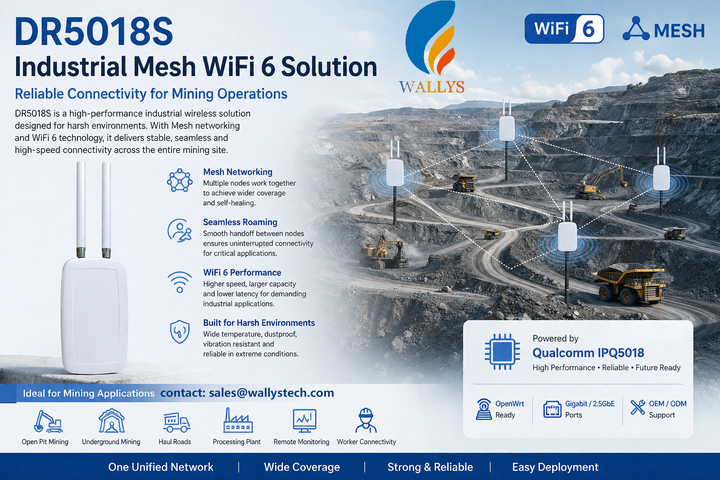
Key Benefits of Mesh WiFi
1. Wider Wireless Coverage
Multiple Mesh nodes can cover large areas such as hotels, office buildings, factories, warehouses, campuses, and mining sites, significantly reducing WiFi dead zones.
2. Easy Network Expansion
As your business grows, simply add additional Mesh nodes to extend coverage without redesigning the entire network infrastructure.
3. Reliable Connectivity
Mesh networks intelligently optimize communication paths. If one node experiences interference or becomes unavailable, traffic can automatically be redirected through other available nodes, improving network reliability.
4. Simplified Deployment and Maintenance
Most Mesh solutions support automatic networking and centralized management, reducing installation time and lowering long-term maintenance costs.
Mesh WiFi vs. Traditional Access Points
Traditional wireless networks typically consist of multiple independent access points, each requiring individual configuration and management. As users move between coverage areas, devices may experience connection interruptions or need to reconnect manually.
Mesh WiFi creates a unified wireless network where multiple nodes work together. Combined with fast roaming technologies, Mesh solutions provide a much smoother experience for users moving throughout the network.
Where Is Mesh WiFi Used?
Mesh WiFi is widely deployed across various industries, including:
- Hotels and resorts
- Corporate offices
- Schools and universities
- Hospitals and healthcare facilities
- Warehouses and logistics centers
- Manufacturing plants
- Shopping malls
- Smart campuses
- Industrial IoT (IIoT)
- Mining operations
- Smart city infrastructure
Any environment requiring large-area wireless coverage, mobility, and easy scalability can benefit from Mesh networking.
Why Are More Businesses Choosing Mesh WiFi?
As mobile devices, IoT equipment, and wireless applications continue to grow, enterprise networks must support higher capacity, better coverage, and greater reliability.
Compared with traditional wireless architectures, Mesh WiFi offers several significant advantages:
- Unified wireless coverage
- Flexible network expansion
- Simplified installation
- Lower maintenance costs
- Improved network reliability
- Better user experience
For industries such as hospitality, education, healthcare, manufacturing, mining, logistics, and industrial automation, Mesh networking has become a preferred solution for modern wireless infrastructure.
Build Industrial Mesh Networks with DR5018S
The DR5018S is a high-performance WiFi 6 platform designed for enterprise and industrial wireless applications. Supporting Mesh networking, it enables system integrators, OEM manufacturers, and solution providers to build scalable wireless products for demanding environments.
Typical applications include:
- Industrial Mesh WiFi
- Mining Wireless Networks
- Factory Automation
- Warehouse Connectivity
- Smart Campus Networks
- Outdoor Wireless Coverage
- Enterprise WiFi Solutions
- Industrial IoT Gateways
With its powerful hardware platform, flexible software architecture, and support for customized development, the DR5018S provides a reliable foundation for next-generation wireless networking solutions.
Conclusion
Mesh WiFi is transforming the way enterprise and industrial wireless networks are deployed. By providing wider coverage, easier expansion, and more reliable connectivity, Mesh technology helps businesses build wireless infrastructures that are ready for future growth.
If you are looking for a WiFi 6 Mesh solution, Industrial Mesh Router, Enterprise Mesh Network, or an OEM/ODM Mesh platform, the DR5018S offers the performance and flexibility needed for modern wireless applications.
Comments
Post a Comment