Why IPQ5018 Continues to Thrive in the Wi-Fi 7 Era
As more vendors promote Wi-Fi 7, Multi-Link Operation (MLO), and the 6 GHz spectrum, it is easy to assume that Wi-Fi 6 platforms are gradually fading from the spotlight. However, in real-world deployments across enterprise networks, smart hospitality, industrial campuses, and outdoor wireless infrastructure, Qualcomm's IPQ5018 continues to power a significant number of new projects.
The reason is straightforward. Most network deployments are not built around achieving the highest theoretical throughput. What customers truly value is a wireless platform that is stable, mature, cost-effective, and capable of supporting large-scale deployments over many years.
As one of the most successful platforms of the Wi-Fi 6 generation, the IPQ5018 has earned its reputation through reliability.
Built on a proven architecture and supported by a mature software ecosystem, the platform has undergone years of validation across enterprise environments, service provider networks, and industrial applications. While newer technologies continue to evolve, the IPQ5018 benefits from extensive field experience and long-term deployment history. For many customers, a proven platform often represents lower risk and greater confidence than adopting the latest technology before it reaches full maturity.
This advantage becomes particularly evident in Mesh networking applications.
As wireless coverage requirements continue to grow, single-access-point deployments are no longer sufficient for many homes, offices, hotels, warehouses, and industrial facilities. Mesh networking has become an essential solution for extending coverage while maintaining a unified user experience.
However, effective Mesh networking involves much more than simply connecting multiple access points. It requires intelligent node discovery, dynamic path optimization, traffic balancing, and network self-healing capabilities. Thanks to years of development and optimization, the IPQ5018 platform delivers mature support for EasyMesh, BATMAN-adv, and Qualcomm Mesh architectures, enabling system integrators to shorten development cycles while providing end users with a more dependable wireless experience.
Whether deployed in hotels, office buildings, logistics centers, industrial plants, or large residential environments, IPQ5018-based Mesh systems can expand coverage efficiently while maintaining network stability. Additional nodes can be integrated seamlessly, allowing networks to scale without the complexity traditionally associated with wireless expansion.
Coverage, however, is only part of the equation.
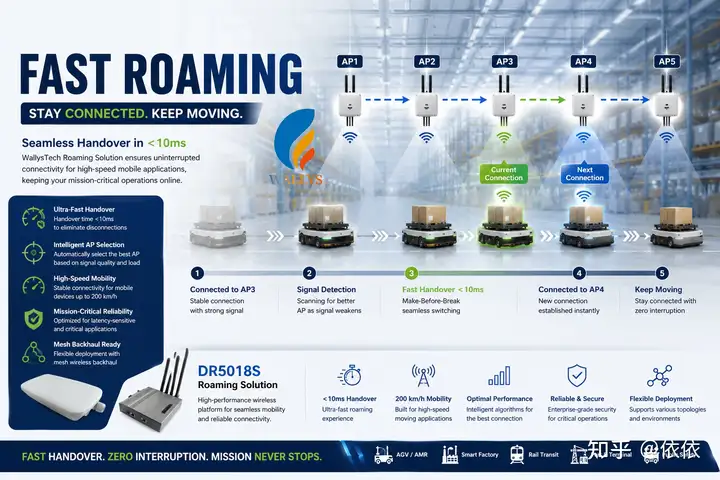
As mobile devices move between access points, roaming performance becomes equally important. Few things are more frustrating than a video conference freezing while walking through an office, a warehouse scanner losing connectivity during operation, or an autonomous vehicle experiencing network interruptions while moving across a facility.
To address these challenges, the IPQ5018 fully supports 802.11k, 802.11v, and 802.11r roaming technologies. These mechanisms enable client devices to identify neighboring access points in advance, receive intelligent transition guidance, and complete authentication more efficiently during handoffs. The result is a smoother roaming experience with reduced service interruption, which is particularly valuable for voice communications, real-time applications, and industrial mobility solutions.
This combination of reliable Mesh networking and seamless roaming is one of the reasons why IPQ5018 continues to be widely adopted across enterprise Wi-Fi, hospitality networks, educational campuses, industrial automation systems, logistics facilities, and carrier-grade wireless equipment.
Naturally, the platform does not offer some of the latest capabilities introduced by Wi-Fi 7, such as native 6 GHz operation and Multi-Link Operation. In ultra-high-density environments or applications requiring the lowest possible latency, newer Wi-Fi 7 platforms may provide additional advantages.
Yet for many commercial deployments, the primary objective remains delivering a stable and reliable network while maintaining a reasonable total cost of ownership. In these scenarios, platform maturity often outweighs the benefits of cutting-edge specifications.
That reality explains why the IPQ5018 continues to maintain strong market relevance even as the industry transitions toward Wi-Fi 7.
For equipment manufacturers, a proven platform reduces development risk and accelerates time-to-market. For network operators and end users, it delivers confidence through years of demonstrated performance in real-world environments.
From enterprise offices and smart hotels to industrial IoT deployments and outdoor wireless infrastructure, the IPQ5018 continues to demonstrate an important principle: the value of a wireless platform is not measured solely by peak throughput, but by its ability to provide stable, dependable connectivity day after day, year after year.


Comments
Post a Comment